
Texas’s Deadliest Hurricane: 1900 Galveston and Lessons for Today
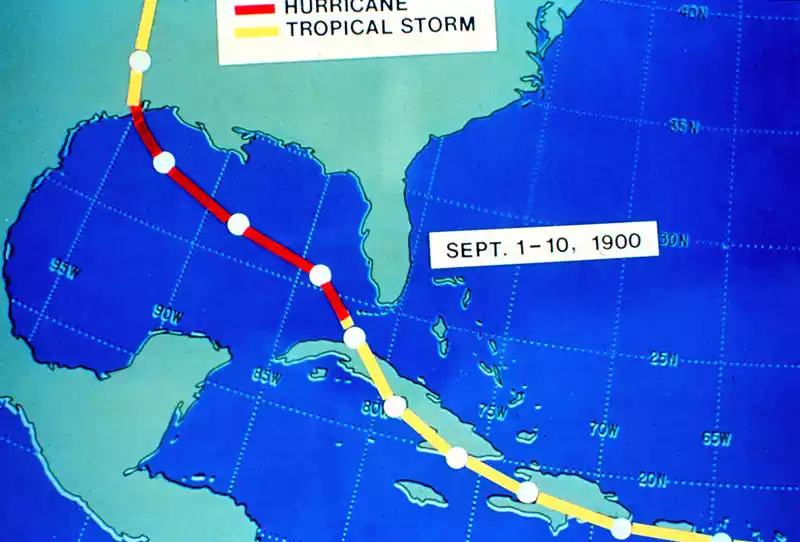
Texas has endured countless weather-related disasters, from the recent heartbreaking floods in Central Texas to the historic 1900 Galveston Hurricane, each leaving a profound mark on the state’s communities. That Category 4 hurricane, the deadliest weather-related natural disaster in US history, struck Galveston Island on September 8, 1900, unleashing winds estimated at up to 150 mph, with gusts assessed at being up to 200 mph (both figures per National Coast Guard Museum), and a storm surge of an estimated 15.7 feet (per National Park Service). It claimed between 6,000 and 12,000 lives — most estimates settle around 8,000 — and left the thriving port city in ruins. Today, advancements in construction, infrastructure and preparedness help Texas face such storms, yet recent losses and climate change underscore the need for continued and improved vigilance and solidarity.
The 1900 Galveston Hurricane: A Devastating Blow
In 1900, Galveston was a bustling commercial hub with a population of 37,788, the fourth-largest city in Texas at the time. Perched at less than 9 feet above sea level, it was ill-prepared for the hurricane’s fury. The storm surge swept across the island, destroying, per Galveston & Texas History Center (GTHC), 2,636 homes and leaving thousands more damaged. Every structure suffered damage. Drowning and debris claimed most lives, and many survivors endured days trapped under wreckage. The U.S. Weather Bureau’s limited forecasting meant warnings went unheeded, amplifying the tragedy. Galveston’s economic dominance faded as commerce shifted elsewhere, a stark reminder of the disaster’s toll.
Rebuilding with Resilience
The catastrophe spurred action. In 1902, construction began (after an appropriate act had been approved and plans drafted a year earlier) on the Galveston seawall, an over 10-mile-long barrier whose, per GTHC, initial and second segments were completed in 1904 and 1905, respectively, and which was twice extended — first in 1927 and finally in 1963 — to block storm surges. The seawall is now a National Historic Civil Engineering Landmark. Per the Bullock Texas State History Museum, the city, from 1903 to 1911, also raised its elevation by up to 17 feet from pre-1900 levels in key areas, lifting buildings and filling the ground with dredged sand, a remarkable feat, even by today’s standards. When a similar hurricane hit in 1915, the seawall and raised terrain drastically reduced damage and loss of life, proving the value of these measures.
Modern Buildings: A Stronger Stand
Today’s Texas buildings, especially in coastal zones like Galveston, are designed to endure storms of the 1900 hurricane’s magnitude. State and local building codes mandate hurricane-resistant features: reinforced concrete, impact-resistant windows and hurricane straps to anchor roofs. Elevation rules require new structures to sit above flood levels, minimizing surge risks. These standards, born from past lessons, ensure homes and businesses can withstand 140-mph winds and 15-foot surges far better than the wooden structures of 1900. (see details for this section at the end of the article)
The Climate Change Challenge
Yet, rising sea levels and the prospect of more intense hurricanes, driven by climate change, could push modern infrastructure to its limits. A 15-foot surge remains a threat in unprotected areas, and increased storm frequency might overwhelm current defenses. This evolving risk highlights the need for ongoing adaptation — stronger codes, better planning and innovative engineering — to stay ahead of nature’s power.
What Has Worked — and Why It Still Matters
The transformation from 1900 to today reflects human ingenuity at work. The seawall, raised city and tough building codes didn’t emerge from thin air — they came from science, engineering and collective will. Improved forecasting and preparedness stem from decades of learning, not chance. As climate change looms, this same drive must guide us forward. By uniting in purpose and action, we can ensure Texas, the United States and indeed the entire world withstand future storms, proving that our strength lies in progress and cooperation.
_____________________________________________________________________________
Details for Modern Buildings: A Stronger Stand section:
Modern Texas buildings, particularly in coastal zones like Galveston, are designed to endure storms similar to the 1900 hurricane. State and local building codes mandate hurricane-resistant features such as reinforced concrete, impact-resistant windows, and hurricane straps to anchor roofs. These codes are part of the 2018 International Residential Code (IRC) and International Building Code (IBC), adopted by Texas for windstorm insurance eligibility through the Texas Windstorm Insurance Association (TWIA), effective from September 1, 2020.
Modern designs incorporate hurricane-resistant features, as evidenced by the following table summarizing key requirements from the 2018 IRC:
| Feature | Details | Relevant Section |
|---|---|---|
| Windborne Debris Protection | Exterior glazing in wind-borne debris regions (Vult ≥ 130 mph within 1 mile of coast) must meet ASTM E 1996 and E 1886 for impact resistance. | R301.2.1.2 |
| Wind Speed Zones | Zones defined by ultimate design wind speed (Vult), up to 180 mph in coastal areas, requiring specific construction methods. | R301.2.1.2.1, Figure R301.2(5)B |
| Wall Construction | Regulates wood, cold-formed steel, masonry, concrete for wind resistance, with cold-formed steel limited to Vult < 140 mph, Exposure B or C. | R602, R603, R608 |
| Roof Assemblies | Must resist component/cladding loads, with asphalt shingles per ASTM D 7158 for Vult 110-130 mph, requiring hurricane straps for uplift resistance. | R905.2.4.1, R802.11 |
While reinforced concrete is not universally required, it is a common choice for hurricane-prone areas due to its strength, and the codes allow for concrete construction up to 160 mph wind speeds (Exposure B) under R608. Impact-resistant windows are explicitly required in wind-borne debris regions (R301.2.1.2), ensuring protection against flying debris, a major cause of damage in hurricanes. Hurricane straps, or ties, are mandated for roof uplift resistance under R802.11, with capacities designed for high wind loads, ensuring roofs remain anchored during storms.
Elevation rules require new structures to sit above flood levels, minimizing risks from storm surges. This is crucial in areas like Galveston, where buildings must be at or above the Base Flood Elevation (BFE) with added freeboard to reduce water damage, aligning with Texas Gulf Coast building codes. The 2018 IRC and local amendments ensure buildings are elevated to reduce water damage.
Modern buildings are designed per ASCE 7 standards adopted in the 2018 IRC, which include wind load calculations for coastal areas up to 180 mph.
Post-hurricane analyses, such as those following Hurricane Harvey in 2017, show that buildings built to current codes sustained less damage, particularly in elevated and reinforced designs.
Featured image shows the track of the Galveston Hurricane, the deadliest natural disaster in US history. Public domain image by NOAA via NOAA Photo Library.


