
Tesla Unveils Roadster That Drives Upside Down. Critics Call It Useless, but It May Be the Future of Congested Roads
The car that clung to a ramp upside down and barrel-rolled in Texas was dismissed by skeptics as a stunt. A closer look suggests it could one day open a new dimension in how traffic moves.
This is an analysis piece. The traffic proposal below is the author’s own speculation, not a Tesla plan.
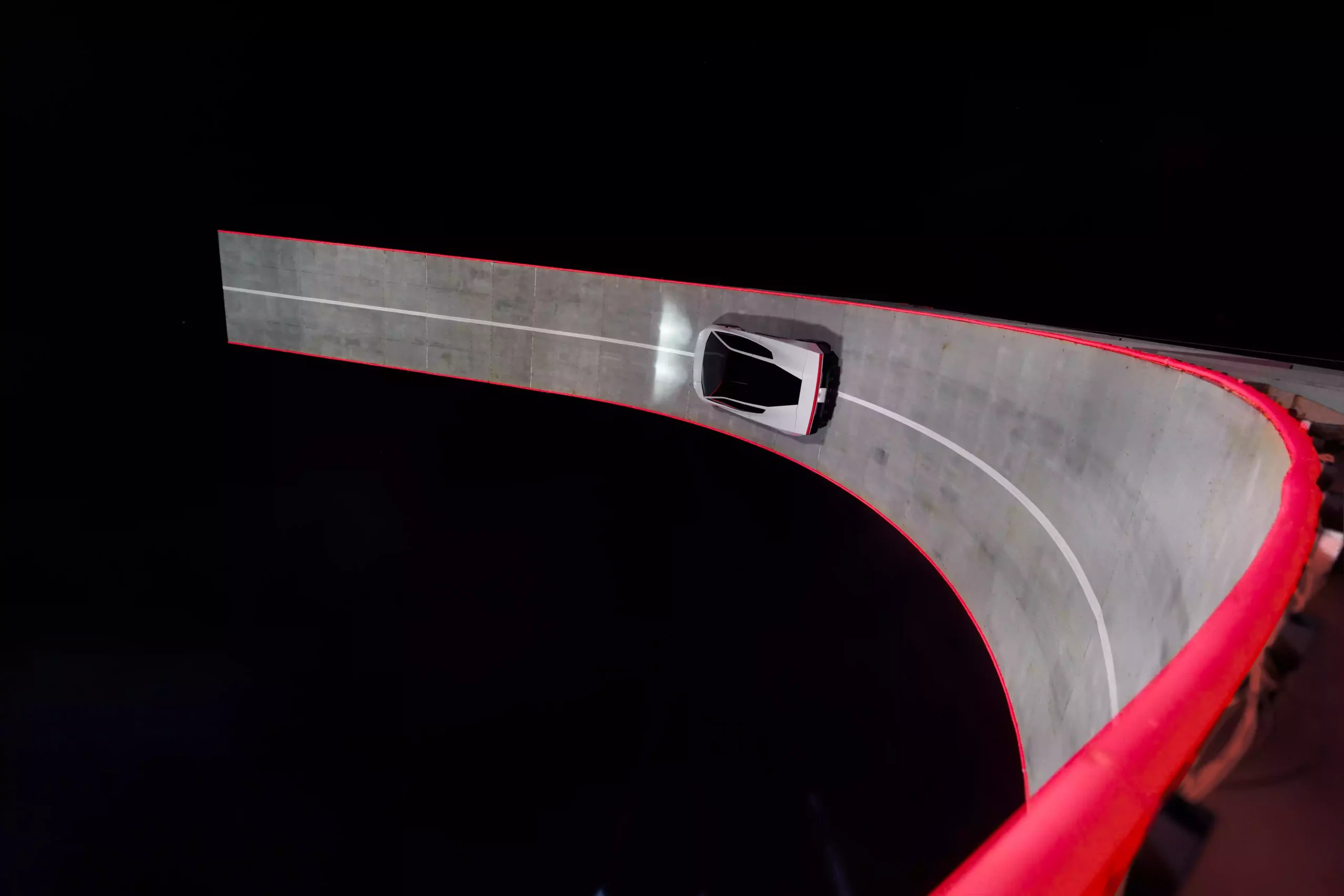
Tesla on Thursday night showed a new Roadster that drove up a curved ramp, hung upside down, launched into the air, rolled and landed on its wheels. The event took place at SpaceX’s test site in McGregor, near Waco. Tesla says the car will go into production in 2028.
Two separate systems made the show possible. A fan-based suction system, which Tesla calls a multi-mode suction system, pins the car to a surface. Reports put that force at about 2Gs, which is enough to hold it upside down. Ten cold-gas thrusters fed by compressed air, a technology borrowed from SpaceX, handle the jumps and rolls.
“Useless,” say the critics
Reaction was sharp. Tech reviewer and Roadster reservation holder Marques Brownlee questioned the 2028 target and the car’s headline claims, asking in a post whether the whole thing was a prank.
Investor Gene Munster of Deepwater Asset Management, a longtime Tesla bull, called the event “an engineering flex with no commercial value beyond embarrassing traditional car makers.”
Opinion writers went further. One commentary headline labeled the car a useless toy built to feed Musk’s ego.
The case for art
Author M.C.A. Hogarth made the opposite argument in a post at 10:19 p.m. Eastern on Thursday, and Elon Musk reposted it without comment. A repost is not a statement of full agreement, but it suggests Musk found her argument congenial.
Hogarth answers the question of why anyone would build a flying car nobody can use by saying that “not everything is about whether you can imagine it being useful to you.” She compares the Roadster to art, made for the glory and challenge of making it. She argues that invention pays off in ways nobody can predict, like a toaster that works better because of something learned elsewhere, and that a barrel-rolling car that drives upside down can inspire people in a way a toaster cannot. She adds that she is “not a car person” and that she makes art, and ends on a joke about looking cool in one. Her full post is below.
Hogarth’s case is that usefulness is not the point. This analysis argues something additional: that the upside-down ability may turn out to be useful as well.
Picture the roads with a new surface
Consider a typical American highway interchange. Every overpass stands on concrete abutments and piers, vertical walls that today do nothing for traffic. They are among the largest unused surfaces in the road network.
Now imagine a purpose-built lane on those walls. A suction-equipped vehicle could drive up the vertical face of an abutment from below, then either flip over the edge or stay inverted and travel along the underside of the deck. It would arrive on the bridge from beneath, bypassing the on-ramp queue entirely.
The author sees three possible benefits.
Extra lanes. A road network has one surface to work with. Walls and undersides would add capacity without acquiring land or widening corridors.
Congestion bypass. A vehicle that can enter a bridge from below does not have to wait in the merge.
Emergency and service access. Ambulances, fire crews, utility trucks and police in pursuit could reach a clogged span by a route no stopped car can block.
The obstacles are real
None of this exists today, and the evidence from the Waco event cuts against quick deployment.
The upside-down run happened on a purpose-built ramp with a smooth, controlled surface. Real concrete is rougher, wetter and dirtier, which affects how suction behaves. The fans need power. The car weighs more than 4,000 pounds, a figure Brownlee cited, so failure mid-wall would be serious. The suction and thruster version is reportedly a $250,000 reservation, and Tesla has not said how many cars would carry it.
Legality is also unanswered. Musk told the crowd this would be “an actual car that’s on the roads,” then walked that back slightly, and Tesla gave no detail on where the thrusters or the suction mode could be used.
The author’s view is that legality is a solvable problem. Road law has been rewritten before when technology arrived, from seat belts to autonomous-vehicle testing rules. If upside-down travel proves safe on designated infrastructure, lawmakers could authorize it on specific routes, with the surfaces engineered for it. That is a prediction, not an assurance.
What to watch
The Roadster itself will be a tiny part of Tesla’s business, which is why Wall Street called the event an engineering flex. But the technology that lets a two-door car hold a ceiling at speed does not have to stay on a stage. If engineers, road agencies and lawmakers ever decide that vertical concrete is a resource, the first car to use it will look a lot like the one that hung upside down in McGregor on Thursday.
Hogarth’s post says the car was made for love and passion. Both things may be true: that it began as art, and that it ends up carrying traffic.
Featured image shows Tesla Roadster driving upside down on the ramp at the McGregor, Texas event. Photo is courtesy of Tesla, Inc.


