
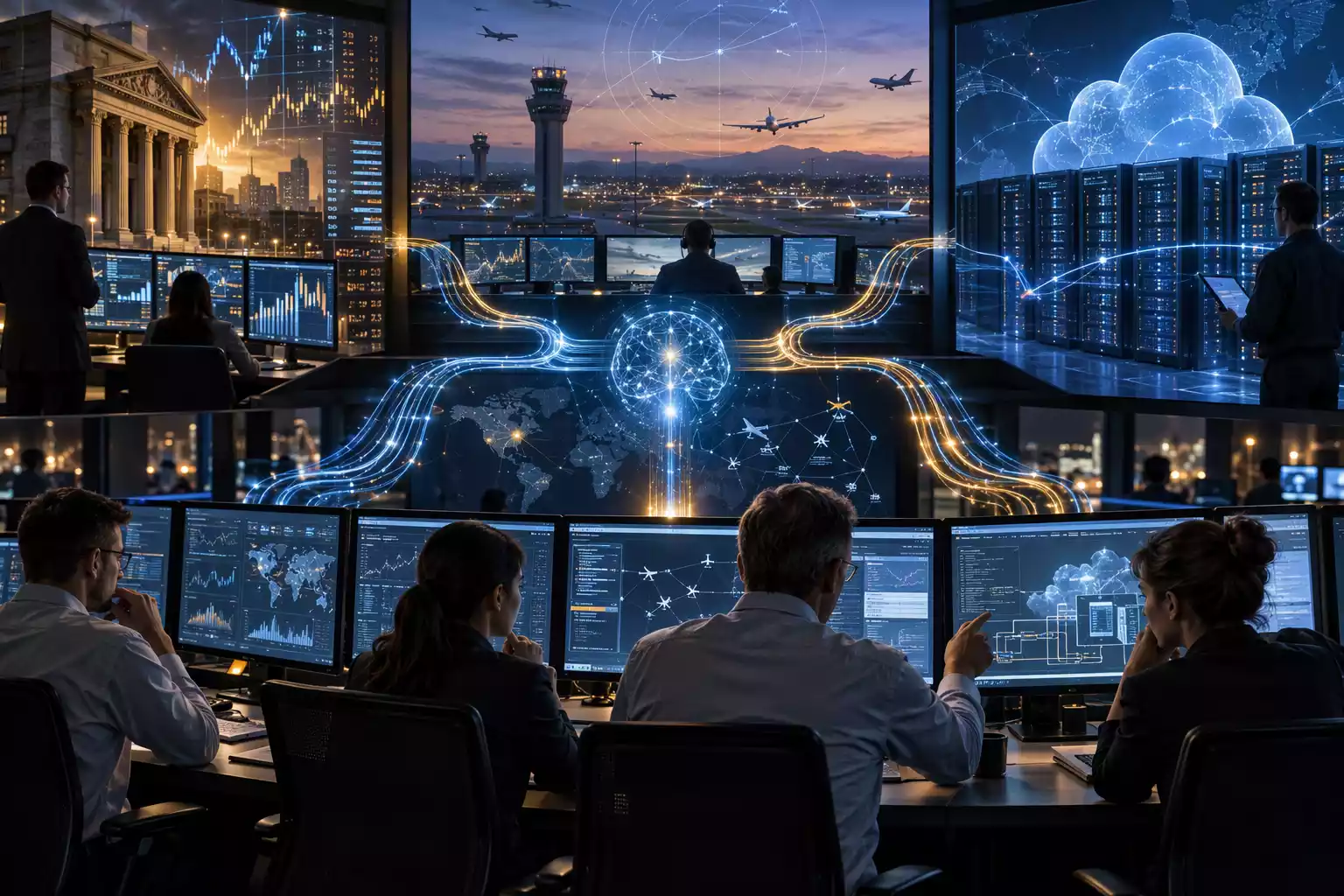
As AI Enters Critical Infrastructure, How Much Reliability Is Enough?
ANALYSIS
Recent disruptions affecting major banks, Microsoft services and the Federal Aviation Administration (FAA) have raised concerns about the resilience of the digital systems that modern society depends upon.
Customers of major banks, including Chase and Wells Fargo, experienced online banking problems. Microsoft recently dealt with a significant Microsoft 365 outage. The FAA was forced to issue a nationwide ground stop after communications-related issues disrupted operations. Public reporting has attributed these incidents to technical failures, software bugs, infrastructure upgrades and telecommunications problems. There is currently no public evidence that artificial intelligence caused these events.
Yet these incidents raise a broader question that extends beyond any single outage.
How much critical technical work within banks, government agencies, aviation systems and major technology companies has already been assigned to AI systems or AI agents?
That question is becoming increasingly important as organizations race to integrate AI into software development, operations, customer service, cybersecurity, data analysis and decision-support systems.
The issue is not whether AI is useful.
It clearly is.
AI can increase productivity, assist engineers, accelerate research, process enormous volumes of data and automate repetitive tasks that would otherwise consume significant human effort.
The issue is reliability.
Most major AI models continue to carry disclaimers warning users that mistakes can occur. Those warnings exist for a reason. AI systems can generate incorrect information, make flawed assumptions, misunderstand context and occasionally produce outputs that are difficult to explain.
In most situations, those errors are manageable.
If an AI assistant drafts an imperfect email or summarizes a document incorrectly, a human can review the output and make corrections.
But the stakes become much higher when technology is connected, directly or indirectly, to critical infrastructure.
Banking systems move money.
Aviation systems help keep aircraft separated safely.
Government systems deliver public services.
Technology platforms power communication, productivity and commerce for millions of people.
The consequences of failure in these environments are fundamentally different.
Supporters of AI deployment often make an entirely reasonable point: Humans make mistakes too.
That is true.
However, society has spent decades developing procedures, regulations, certifications, audits, testing standards and accountability mechanisms designed to reduce human error in critical environments.
The challenge facing organizations today is determining how those standards should evolve for AI.
Importantly, the public may not always know where AI is being used.
When a bank, airline, government agency or technology company experiences a technical problem, the organization itself may not have designed every system or written every line of code involved.
Modern institutions rely on extensive networks of vendors, contractors, subcontractors, consultants, cloud providers and third-party software suppliers.
A technical failure that appears to have occurred at a bank or government agency may actually originate somewhere within a much larger supply chain.
That reality introduces another question.
As AI coding assistants and AI agents become more common, how much contractor-developed software is now being written, modified, reviewed, tested or maintained with AI assistance?
The public currently has very little visibility into that issue.
To be clear, asking the question is not the same as alleging that AI caused any recent outage.
No such evidence has been presented publicly regarding the recent banking disruptions, Microsoft’s service outage or the FAA ground stop. Available reporting instead points toward technical and infrastructure-related causes.
Nevertheless, the question remains relevant because AI is steadily moving closer to the operational core of critical systems.
The topic has received sufficient attention that organizations such as the National Institute of Standards and Technology and the Department of Homeland Security have launched initiatives specifically focused on trustworthy AI and the safe deployment of AI within critical infrastructure.
These efforts acknowledge that as AI adoption increases, issues of trustworthiness, risk management, oversight and reliability become increasingly important.
The debate, therefore, should not be framed as being for or against AI.
A better question is whether society has established appropriate standards for determining when an AI system is reliable enough to be trusted with increasingly important responsibilities.
What level of testing should be required?
What degree of transparency should organizations provide regarding AI involvement in critical operations?
How much human oversight should remain mandatory?
And if AI-generated work contributes to a failure, who ultimately bears responsibility?
These questions become more urgent as AI systems become more capable and more embedded within the infrastructure that supports daily life.
The recent banking disruptions, Microsoft outage and FAA ground stop may ultimately have nothing to do with AI.
But they serve as a useful reminder that reliability matters.
Before AI takes on a larger role in critical infrastructure, the public deserves a clear understanding of how reliability is being measured, how risk is being managed and how trust is being earned.
That conversation should occur before society becomes dependent on systems whose capabilities may be advancing faster than our ability to evaluate them.


